- A PG&E substation fire knocked out power to 130,000 San Francisco homes, December 20, 2025.
- Waymo's remote fleet response queue collapsed when too many vehicles requested human confirmation simultaneously.
- The fleet navigated over 7,000 dark signals that day; a subset became immobilized at intersections.
- Twenty 311 complaints were filed about Waymos blocking traffic.
- Waymo suspended all service at 7:21 PM and published an incident blog post on December 24, 2025.
01 — The BlackoutSaturday, 2:30 PM
It started with a fire. At 2:30 p.m. on Saturday, December 20, 2025, a blaze broke out at a PG&E electrical substation in San Francisco. Within minutes, signal lights began going dark across the city. By the time the outage peaked, nearly 130,000 homes and businesses had lost power — one of the largest blackouts in the city's recent history.
For most of San Francisco, this was an inconvenience. For Waymo's fleet of robotaxis, it was the scenario their software had been explicitly designed to handle. Autonomous vehicles are supposed to treat a non-functioning traffic signal as a four-way stop: proceed carefully, yield appropriately, keep moving. Waymo had trained for this. Their engineers had written code for this.
Then the lights went out, and the cars stopped.
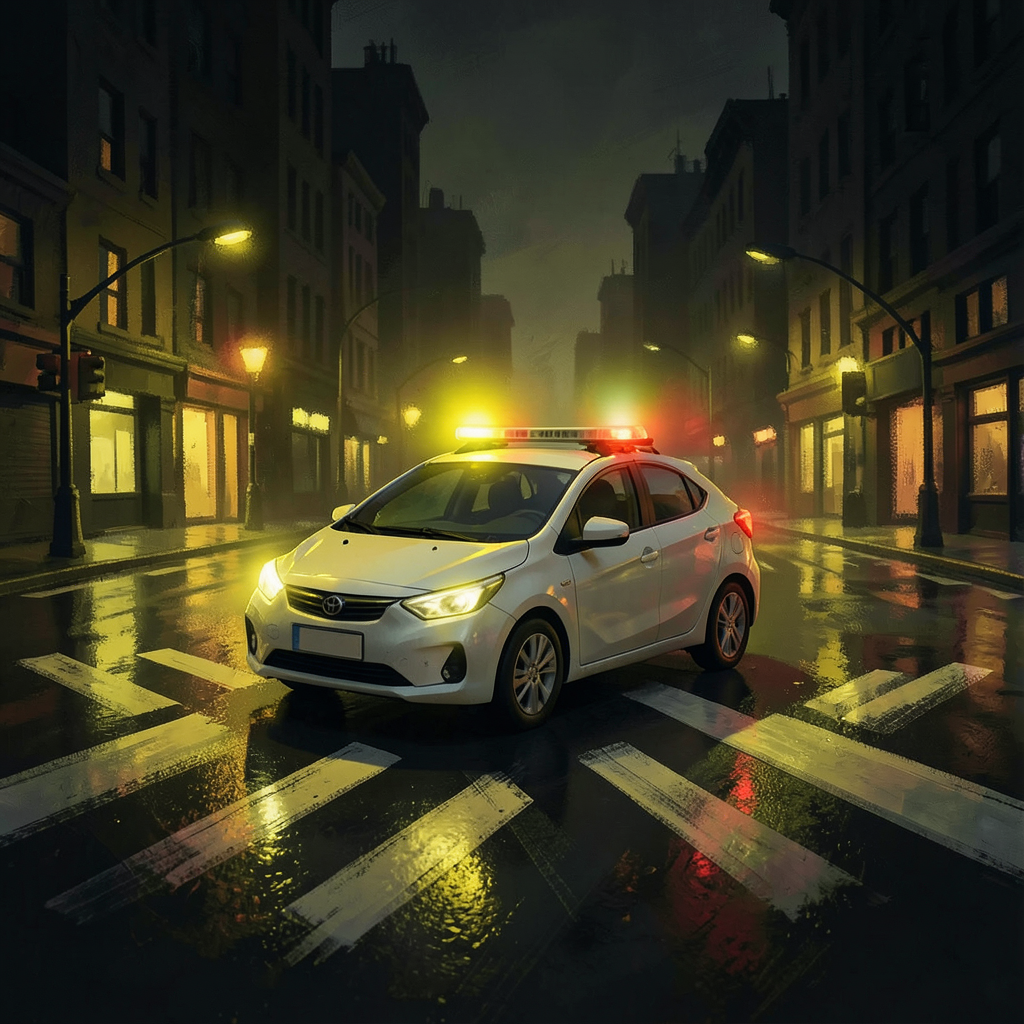
Grid Lock — Autonomous vehicles move in orderly paths. The power goes out. Every car stops exactly where it is. Hazard lights pulse in the dark — waiting for a human who never comes.
02 — The FreezeHazard Lights in the Dark
Videos circulated on social media within the hour. In North Beach, at least four Waymo vehicles sat in the middle of an intersection, hazard lights blinking in the dark, completely stationary. A queue of human-driven cars waited behind them. Nobody could get through. Nobody came to move the Waymos. They just sat there, amber lights pulsing, waiting.
At Divisadero and Geary — the location of the first 311 call — the situation was the same. The light overhead was dark. The car below it wasn't moving. The signal map of 311 complaints that evening mirrored PG&E's outage map almost exactly: wherever the power went out, the Waymos stopped.
That last number is important. Waymo's cars handled more than 7,000 darkened signals that day without incident. The vast majority of the fleet did exactly what it was designed to do. The problem wasn't that the cars couldn't handle dark signals. The problem was what happened when too many of them were uncertain at the same time.
03 — The Confirmation CheckA Queue That Couldn't Keep Up
Waymo's vehicles don't operate entirely alone. When a robotaxi encounters a situation it's uncertain about — an unusual obstruction, an ambiguous signal, an edge case the software hasn't confidently resolved — it can ping Waymo's remote fleet response team and request a confirmation check: a human operator who reviews what the car is seeing and approves the next action.
In normal operation, this is a safety feature. It's the human-in-the-loop that autonomous vehicle companies use to handle edge cases at scale. One or two cars requesting confirmation at any given moment is manageable. What happened on December 20 was not one or two cars.
Waymo later explained it this way: the scale of the outage created a "concentrated spike" in confirmation requests that the assistance pipeline couldn't absorb. Thousands of vehicles, each uncertain about a darkened intersection at the same moment, each individually doing the right thing by asking for help — collectively overwhelmed the system that was supposed to help them.
The cars weren't broken. The code wasn't wrong. The architecture had a ceiling, and the blackout hit it all at once.
04 — The DiagnosisNot a Bug. A System.
By the following morning, industry experts were weighing in. The verdict was pointed.
The distinction matters. A software bug can be patched. An operational management failure is a systems design problem — a gap between what the technology can do autonomously and what it needs humans to backstop. Waymo had built a fleet that worked, mostly, on its own. When it didn't, it leaned on a human infrastructure that was sized for normal conditions, not citywide emergencies.
A power outage isn't a fringe scenario for a city like San Francisco. Earthquakes, fires, floods, storms — infrastructure failures are part of the operating environment. The SFMTA and city officials had been raising concerns about exactly this kind of resilience for years.
The Mercury News posed the question directly: What happens in the next emergency — an earthquake?
05 — The PatternThis Wasn't the First Time
The blackout incident didn't arrive in a vacuum. Waymo's San Francisco rollout had been generating friction with city officials and emergency services since it began commercial operations in 2023.
Each incident, taken alone, was explainable. Software edge cases, unexpected environments, the inevitable friction of deploying new technology at scale. Together, they described a technology that was genuinely impressive — and genuinely not finished.
06 — The ReckoningFleet Updates and Unanswered Questions
Four days after the blackout, Waymo published a blog post. They announced fleet-wide updates: vehicles would receive "more context about regional outages," emergency response protocols would be improved, and the company would coordinate more closely with Mayor Lurie's office on emergency preparedness. They acknowledged that 7,000-plus dark signals had been handled successfully, and they acknowledged that some had not.
They did not say how many cars had frozen in place. When a California Public Utilities Commission judge asked that question directly at a January 2026 hearing, Waymo's representative said the number was a trade secret.
The CPUC indicated it would rule on whether the figure constituted a trade secret. The ruling hadn't come by the time this story was published.
What the blackout revealed wasn't that Waymo's cars had failed. Most of them hadn't. It revealed something more structural: that a fully autonomous fleet, operating at scale in a city with real infrastructure fragility, depends on a human support system that can be overwhelmed. The autonomy isn't complete. It's a dial, not a switch. And when the city went dark, the dial got turned past what the support system could handle.
The cars kept their hazard lights on. They were doing exactly what they were supposed to do when stopped unexpectedly. They were asking for help.
There just weren't enough people to answer.
What if the next time a fleet freezes, it isn't blocking Saturday commuters — it's blocking the ambulances, fire trucks, and evacuation routes responding to the kind of emergency that turns a bad day into a catastrophe, while the confirmation queue waits?
Sources
More Stories
 Ch21
Ch21  Ch19
Ch19  Ch22
Ch22  Ch23
Ch23