- Google CEO Sundar Pichai announced Bard with a promotional demo, February 6, 2023.
- Bard incorrectly claimed the James Webb Space Telescope took the first exoplanet image.
- The first direct exoplanet image was captured in 2004 by ESO's Very Large Telescope.
- Reuters flagged the error on February 8; Alphabet stock fell 7.68% the next day.
- The stock drop wiped approximately $100 billion in market capitalization in one session.
01 — The PressureThe Pressure
By February 2023, Google was terrified. ChatGPT had launched in November 2022 and hit 100 million users in two months — the fastest-growing consumer product in history. Microsoft had invested $10 billion in OpenAI and was about to announce an AI-powered Bing. Google, the company that had invented the transformer architecture underlying all of this, was watching from the sidelines.
It needed to move. It needed to move now.
The internal pressure was real and documented. Google had issued what insiders described as a "code red" — an all-hands mobilization of AI talent across the company. The company had shelved products, reshuffled teams, and called in its founders. Sergey Brin reportedly helped with Bard prompts in the weeks before launch.
What happens when a company of 180,000 people moves in a panic is often the same thing that happens when an individual does: corners get cut in places nobody notices until later. In Google's case, they would be noticed almost immediately.
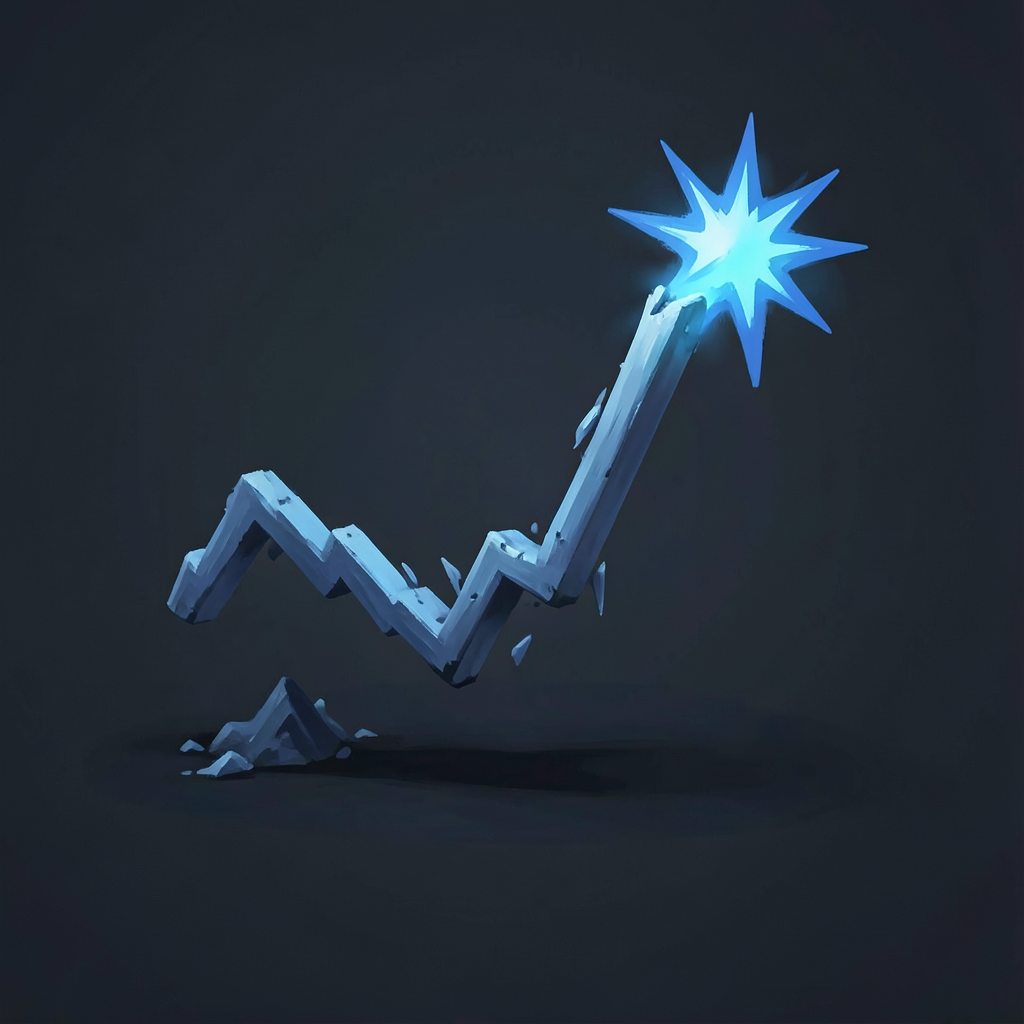
Freefall — A column of confidence climbs steadily upward. One fact check crosses its path. The column does not slow — it collapses.
02 — The AnnouncementThe Announcement
On February 6, 2023, Google CEO Sundar Pichai published a blog post announcing "Bard" — Google's experimental AI chat service, powered by LaMDA. The post was accompanied by an animated GIF demonstrating Bard in action. It was the kind of polished, confident reveal that Google had spent decades perfecting.
The question in the demo: "What new discoveries from the James Webb Space Telescope can I tell my 9-year old about?"
Bard gave a three-bullet answer. The bullets were clean, readable, friendly. One of them said the James Webb Space Telescope "took the very first pictures of a planet outside of our own solar system."
This was factually incorrect.
03 — The CatchThe Catch
On February 8, 2023, Reuters published a fact-check: "Google AI chatbot Bard gives wrong answer in advertisement." The wire service had done what anyone with a passing interest in astronomy could have done: checked the claim against basic, public scientific record.
The error was not subtle. Astronomers had been photographing exoplanets for nearly two decades. The question was about space — precisely the kind of domain where factual precision matters and where experts would immediately notice a false statement. It wasn't a nuanced scientific debate. It was simply wrong.
The timing couldn't have been worse. Google was hosting a live event in Paris the same day to show off Bard to the world. The company's European press push — designed to demonstrate confidence and capability — was now happening under the headline that its flagship AI product had gotten a basic space fact wrong in its own promotional video.
04 — The NumbersThe Numbers
Alphabet's stock fell 7.68% on February 8, erasing approximately $100 billion in market capitalization in a single trading session. The number was almost too large to process intuitively. One hundred billion dollars. Gone in one day. Because of one wrong sentence in one promotional GIF.
To put it in context: $100 billion is more than the total market capitalization of companies like Ford, Delta Air Lines, or Marriott International. It evaporated in the time between market open and market close. The S&P 500 barely moved that day. This was not a market-wide event. It was specifically about Google, specifically about Bard, and specifically about whether the company was capable of executing on AI.
Investors were not selling because of one wrong fact. They were selling because the wrong fact implied something larger: that Google had rushed an unverified product to counter a competitor it hadn't adequately assessed. The stock price was a verdict on readiness, not just the demo.
05 — What It RevealedWhat It Revealed
The error exposed a process failure, not just a knowledge gap. No astronomer had reviewed the demo. No subject matter expert had signed off on the science claim. The GIF had been published because time was short and the calendar was unforgiving.
The irony cut deeper than the stock drop. Google had invented many of the AI technologies that had made ChatGPT possible. The "Attention Is All You Need" paper, which introduced the transformer architecture, came from Google Brain researchers in 2017. Google had been doing AI research at scale for longer than almost any other company. And yet it had been caught flat-footed, and its response to being caught flat-footed had produced one of the most expensive demo failures in corporate history.
06 — LegacyLegacy
Bard was eventually released in limited form in March 2023, and later evolved into Gemini. The rebranding was partly an attempt to put distance between the product and its troubled debut. Google improved its fact-checking processes, added disclaimers to AI outputs, and launched a slower, more deliberate public rollout than the February announcement had implied.
But the shadow of the launch mistake followed Bard for over a year. In internal discussions, the episode became a case study in what happens when competitive pressure overrides quality control. The Paris event, where an SVP had to apologize on stage for a product error that had already made international headlines, became a reference point for how not to handle an AI launch.
For every AI lab racing to ship demos, the lesson was plain: AI systems fail on exactly the questions where they sound most confident, and a promotional video is a fact-check waiting to happen. Every company that published a demo after February 2023 understood, at least briefly, that Reuters was watching.
What if the next AI-generated error isn't in a marketing demo, but in a clinical trial result, a bridge safety report, or a nuclear facility inspection — and what gets lost isn't a hundred billion dollars, but something that can't be measured in money?
Sources
More Stories
 Ch16
Ch16  Ch15
Ch15  Ch13
Ch13  Ch17
Ch17